Why AI is like what came before
AI resembles past general-purpose technologies in the way that matters most: its value depends on complementary innovation. The technology on its own is not the system. The payoff rides on data quality, workflow redesign, training, evaluation, integration, governance, and organizational learning.
NBER research on general-purpose-technology adoption stresses that productivity depends not just on the technology but on firm-specific benefits and the co-invention costs that surround it. That goes double for AI, where the models are general but the value is intensely local.
A language model can draft a contract clause, but whether that draft is any use depends on the company's legal standards, jurisdiction, risk posture, negotiation context, and review process. The model is one component in a larger operating system, and the other components still have to be built.
Difference one: it targets high-skill work
The first real difference is what AI touches. The IMF estimates that almost 40 percent of global employment is exposed to AI, climbing to roughly 60 percent of jobs in advanced economies, and points out that, unlike earlier waves of automation and IT, AI has a distinctive reach into high-skilled work.
Exposure is not the same as disappearance. It means tasks inside those jobs may be automated, augmented, restructured, or repriced. What stands out is the breadth, and the reach into professional work. Earlier automation hit factory floors, clerical work, and routine tasks first. AI reaches writing, analysis, legal reasoning, coding, design, and the way managers communicate.
That makes AI organizationally touchy in a way earlier waves were not. It reaches into work tied to status, expertise, and the path up the ladder. So the adoption challenge is not only technical; it is cultural and political. People will want to know whether AI devalues their expertise, whether juniors will still get to learn, and whether the gains turn into support or into layoffs. Those questions deserve straight answers.
Difference two: the barrier to entry is language
The second difference is the interface. The internet needed a connection, a browser, broadband. Enterprise software needed training, configuration, procurement. AI needs a request typed in plain language. That makes adoption faster and messier at the same time.
Employees can be using AI well before the organization has policies, security controls, evaluation methods, or approved workflows. That is why shadow AI is not some edge case; it is a predictable feature of the transition. The very thing that makes AI easy to adopt is what makes it hard to govern.
The low barrier also changes what training has to do. Traditional software training shows people where to click. AI literacy has to teach them how to frame a task, supply context, test outputs, verify sources, protect data, spot failure modes, and know when not to reach for the tool at all. The interface is simple; using it well is not.
Difference three: the jagged frontier
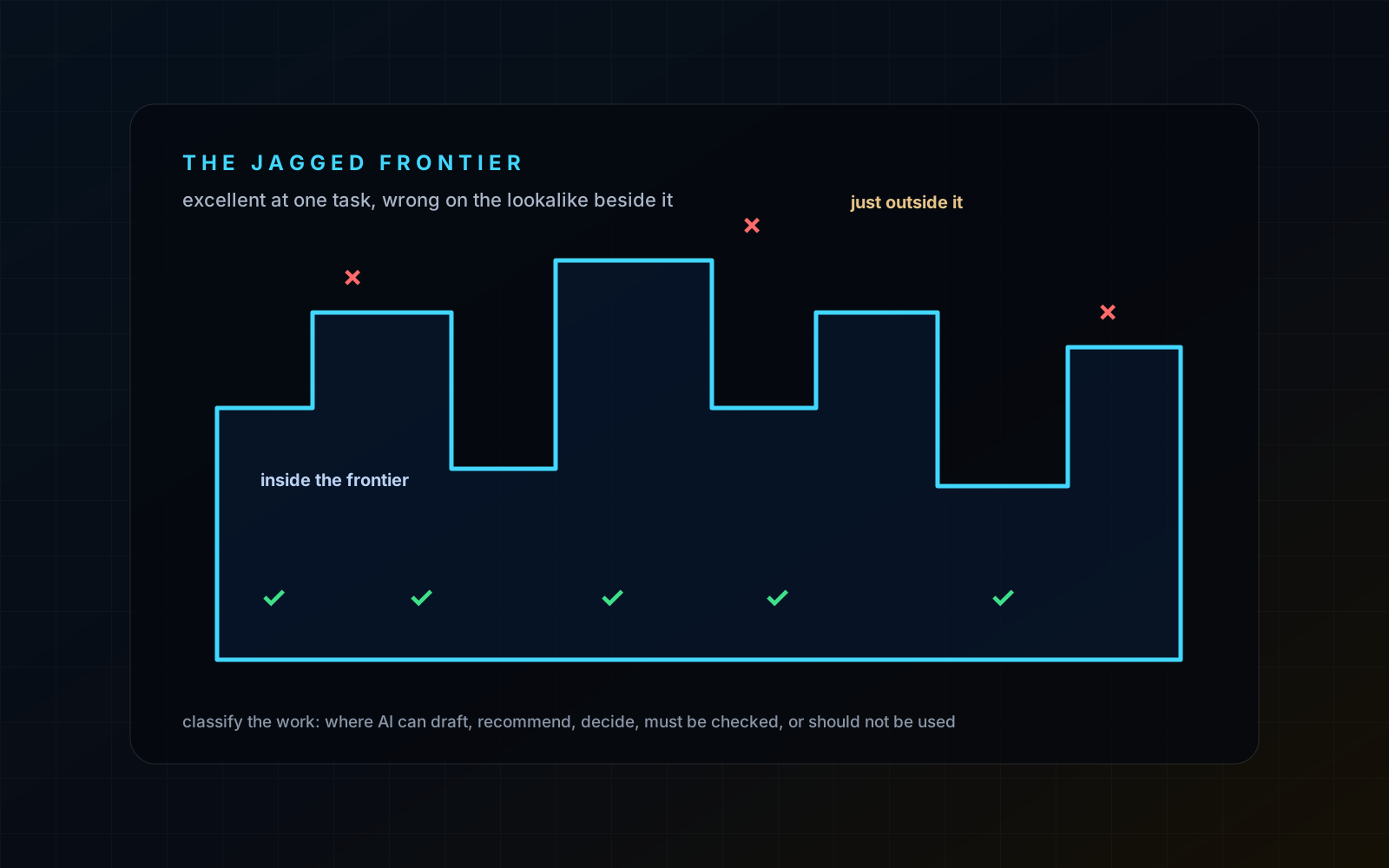
The third difference is the strangest, and the one with the biggest consequences. AI has a jagged frontier. It handles some tasks brilliantly and stumbles on neighboring tasks that look almost the same. A Harvard Business School field experiment with Boston Consulting Group found that consultants using GPT-4 finished more tasks, worked faster, and produced higher-quality work when the tasks sat inside that frontier.
On a complex managerial task picked precisely because it sat outside the frontier, those same AI users were 19 percent less likely to reach a correct solution than consultants working without AI. The tool did more than fail to help. It pulled capable people toward worse answers, because it stayed confident in exactly the territory where it was unreliable.
This is the core management problem with AI: it is unevenly capable, and the line between capable and not is invisible from the output alone. It will summarize a standard policy beautifully and then misread an ambiguous exception with exactly the same fluency.
Designing around inconsistent capability
It helps to spell out the failure modes, because none of them are exotic. AI can write fluent code that compiles and hides a security flaw. It can produce a plausible market analysis built on invented facts. It can draft a customer reply that sounds empathetic and quietly breaks policy. The same tool is useful, misleading, or dangerous depending on the task in front of it.
AI also relates to authority differently than the tools before it. A search engine points you to sources. A spreadsheet shows its formulas if you go look. AI tends to hand back a synthesized answer with no transparent reasoning and no reliable sourcing, delivered in a confident, conversational, finished-sounding voice. That is a persuasion risk in its own right: people believe it because it sounds like it knows.
So you have to treat the output as a draft, a hypothesis, or a recommendation until a defined process has checked it. AI is not untrustworthy across the board; its trustworthiness just swings from task to task, and the confident tone hides the swing.
Which means you need work classification
The practical answer to a jagged frontier is classification. An organization has to decide where AI can draft, where it can recommend, where it can decide, where it must be checked, and where it should not be used at all. Without that, governance collapses into one of two failures.
A blanket use-AI-everywhere policy ignores risk and eventually buys you an incident. A blanket do-not-use-AI policy ignores value and gets quietly ignored, which is worse, because now the usage is unmanaged and hidden at the same time. Neither extreme survives contact with how people actually work.
The workable approach is differentiated control: a lot of freedom where tasks are high-volume and low-risk, tight review where outputs are regulated, financial, legal, safety-critical, or customer-facing, and a clear no where the risk plainly outweighs the value. That map is the foundation for everything in the playbook that follows.