The clearest example of delayed payoff
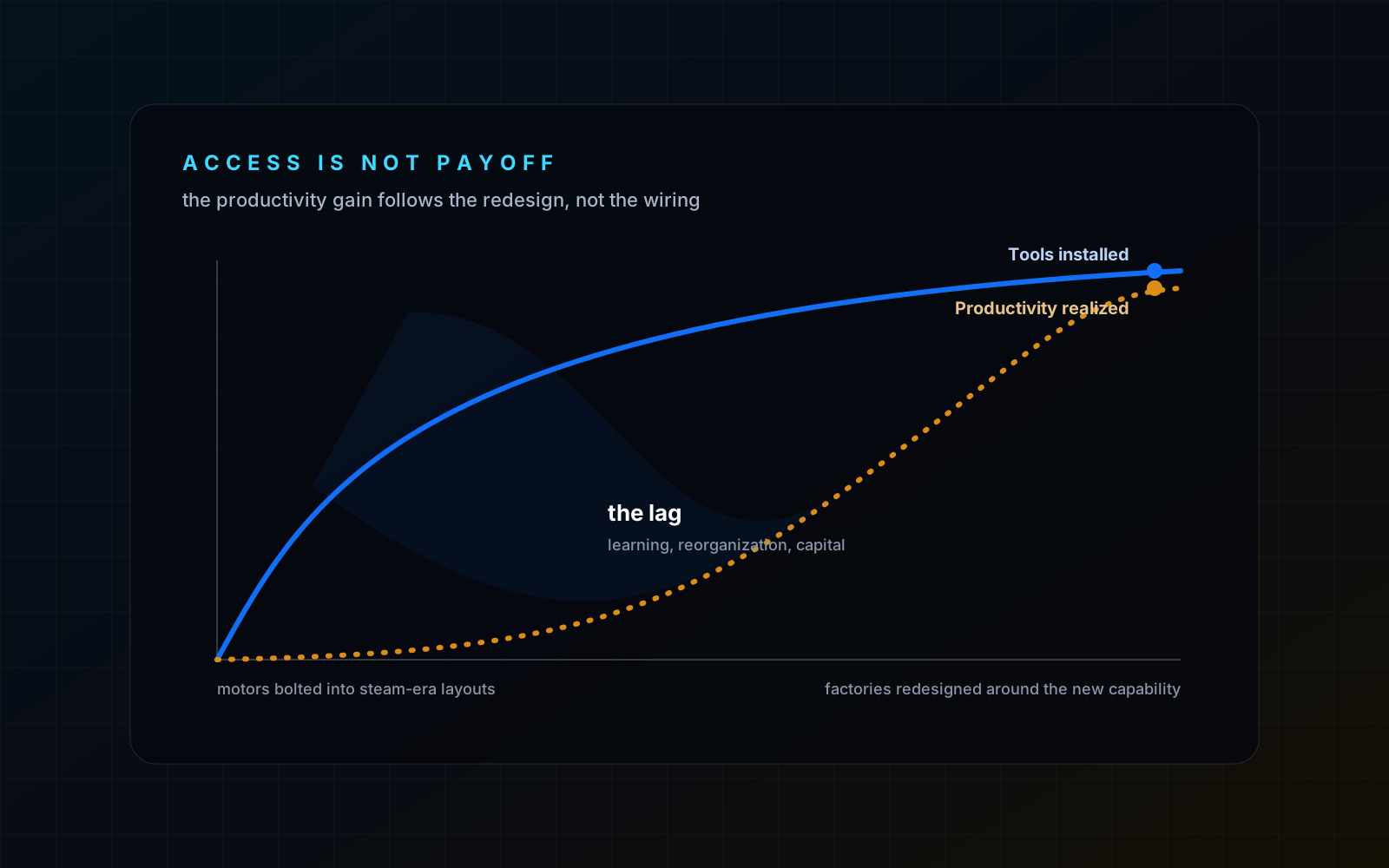
Electricity is the cleanest case of a payoff that showed up long after the technology did. When electric power first reached factories, not much happened at first. Plants mostly dropped electric motors into the spots where steam engines used to sit and left everything else alone. Operations got a little cleaner and a little more flexible, but most of the productivity that electrification made possible stayed locked up.
The real gains came later, once factories were redesigned around what distributed power actually allowed: machines placed by the logic of the work instead of their distance from a driveshaft, more flexible layouts, new production methods, different management practices. The motor sat available for years before the reorganization caught up to it.
None of this is subtle, and it is still easy to forget when results are due this quarter. A motor on every machine changed nothing on its own. The way production was organized had to change with it, and that took experimentation, capital, managerial imagination, and time.
Why a steam-powered factory could not just plug in
A steam-powered factory was built around one central power source. Belts and shafts carried mechanical power through the building, so machines had to be arranged to reach the transmission rather than to suit the flow of work. The shape of the building was really the shape of its power source.
Distributed electric power dissolved that constraint. Give each machine its own motor and it can sit wherever the work makes sense, production can flow differently, and labor can be organized around the process instead of the driveshaft. Cashing that in, though, meant tearing up assumptions baked into the building, the equipment, and the daily management routines.
So firms had to learn what the new technology made possible, and that kind of learning is slow. The first instinct, keep the old layout and just feed it cleaner power, was rational and low-risk. It also left most of the value sitting on the table.
Why the lag is normal
The same lag came back with information and communications technology. The Chicago Fed put it plainly: capturing the benefits of ICT took substantial complementary investment in learning, reorganization, and the like, so the measurable payoff could be delayed for a long time, with electric power offered as the historical parallel.
That reframes the whole productivity delay. The lag never meant the technology lacked value. It meant organizations had not yet built the complementary systems needed to capture that value. The lag lives in the organization, not in the tool.
This is the single most useful thing electricity has to teach us about AI. A gap between adoption and measurable productivity is normal. It is the expected shape of a general-purpose technology grinding its way through institutions that have to change to make room for it.
Expect the same gap with AI
Companies should plan for a visible gap between AI access and AI productivity. Hand employees AI tools and individual tasks improve quickly: drafting emails, summarizing meetings, generating code snippets, producing first-pass research, rewriting customer replies. Those wins are real, and they arrive fast.
Enterprise-level value is a different animal. It takes workflow redesign, new review mechanisms, changed roles, updated controls, revised performance metrics, and new lines of accountability. The tool supplies none of that. It comes from an organization deciding to rebuild the work itself.
A sales team that just lets reps use AI to write emails gets modest gains. The team that rebuilds account planning, call prep, CRM hygiene, follow-up, objection handling, and coaching around AI is playing a different game entirely. Same tool, very different result, and the difference is that one of them rebuilt the system.
Install and wait is the wrong model
The common mistake is to treat the transition as install the technology and wait. History is pretty unkind to that approach. What actually works is closer to install, then redesign, train, govern, measure, and iterate. AI will hand you quick wins, but the advantage that lasts comes from redesigning processes around AI-enabled work.
That distinction has real consequences for budgets and patience. If leaders expect transformation from access alone, the pilots will underwhelm and the program will lose support right before the complementary investments would have paid off. If leaders expect to fund redesign, the early unevenness reads as what it actually is: the cost of learning.
Electrification rewarded the firms that reimagined the factory, not the ones that waited for the motor to do it for them. Expect AI to reward the same instinct: redesign the workflow yourself, because the model will not do it on your behalf.
Patience without passivity
Electricity also teaches a particular kind of patience, the kind that is not passive. A few uneven pilots are not proof that AI has failed. Nor is vague optimism that it will all work out on its own a substitute for doing the work. Both reactions duck the actual job.
The disciplined response to early unevenness is structured learning: set baselines, test specific workflows, find where AI helps and where it fails, redesign the work, then go around again. Productivity comes out of the system built around the tool, and systems like that get built on purpose.
If one thing from the electricity story sticks, make it this: the technology sets the ceiling, but the organization decides how close you get to it. The motor made a better factory possible. Someone still had to go build the better factory.