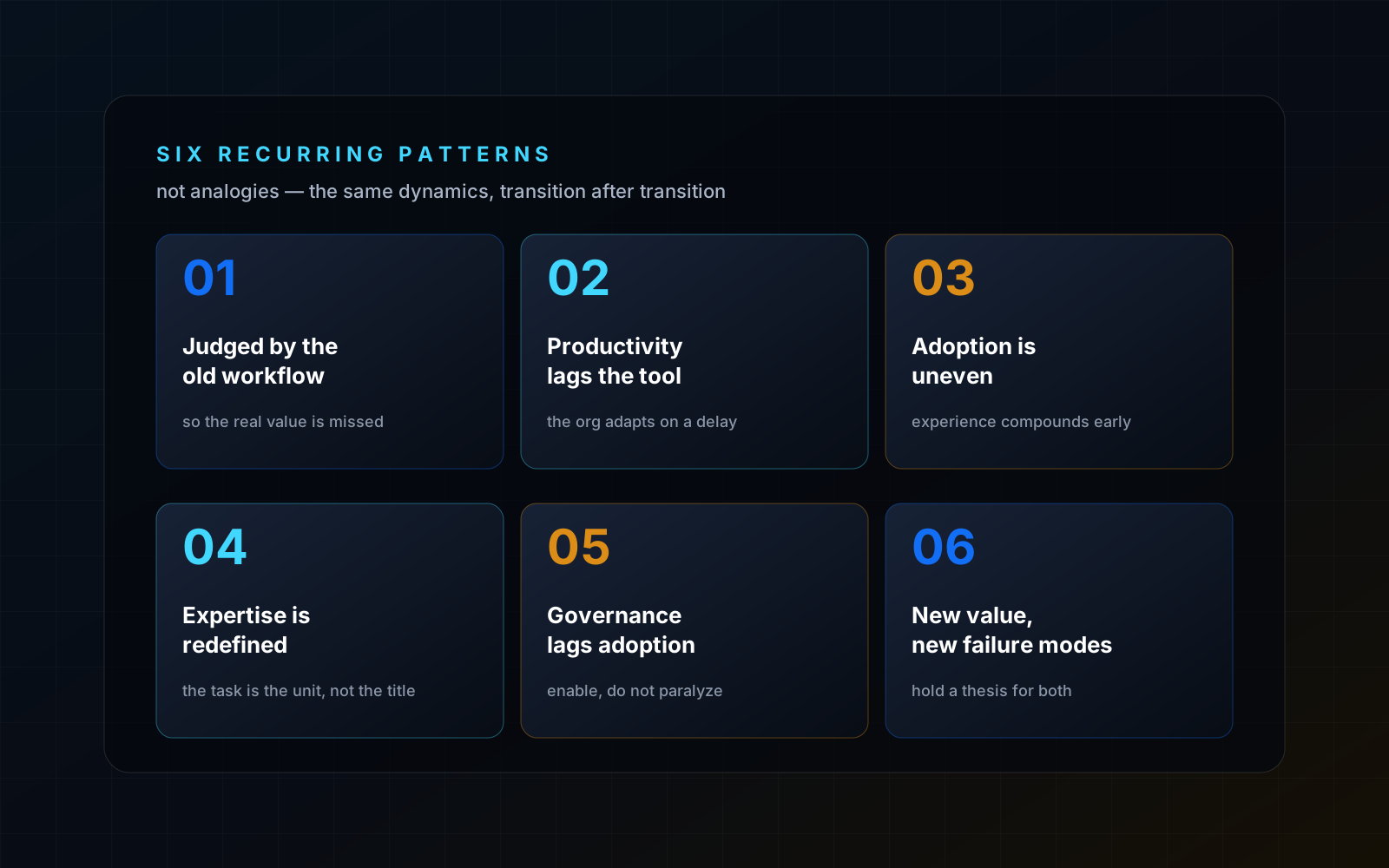
These are dynamics, not analogies
Put electricity, spreadsheets, computers, and the internet side by side and the same patterns keep surfacing. These are not surface-level analogies. They are the organizational dynamics that recur every time, and they decide whether a technology turns into a durable advantage or a source of unmanaged risk.
None of these patterns is destiny. An organization can handle each one well or badly. But seeing them coming turns a confusing transition into a set of recognizable problems with known responses, and that is most of what preparation actually is.
Six of them show up reliably enough to plan around. Each says something specific about how to get ready for AI.
One: the new tool is judged by the old workflow
Major technologies get underestimated because people judge them through the workflow they already run. Observers saw electric motors as stand-ins for steam power, spreadsheets as faster calculators, the internet as a digital magazine rack. Every time, the value that mattered came from workflows that did not exist yet.
AI invites the same mistake. The weak version of adoption asks how to do today's work a little faster. The strong version asks what becomes possible, cheaper, safer, or more scalable once intelligence is built into the workflow itself. Incremental thinking pays out incremental value.
In practice that means not stopping at drafting and summarizing. A customer-service workflow can move from reactive ticket handling to AI-assisted triage, suggested responses, escalation prediction, knowledge-base improvement, quality review, and coaching. The value lives in the redesign, not in the tool that prompted it.
Two: productivity lags tool availability
Productivity gains arrive after the tool, not alongside it, and not because the technology is hollow. The surrounding organization simply has not adapted yet. The San Francisco Fed notes that from the early 1970s through 1995, US business-sector productivity rose about 1.5 percent per year, and that between 1995 and 2003 the pace more than doubled, a stretch tied to the production and use of information technology.
That acceleration came only after years of investment, experimentation, and organizational change. The takeaway is not to sit and wait. It is to expect the lag and fund the complementary work that closes it.
AI may run a compressed version of the same curve. Individuals feel the gains right away; enterprises see them only once AI is built into systems of work rather than offered as a tool people can take or leave. Choose workflows, set baselines, redesign steps, train users, put controls in place, measure, and scale what works. Skip that and adoption ends up a pile of anecdotes instead of an advantage.
Three: adoption is uneven, and experience compounds
Early adopters pile up experience while the laggards are still debating whether the whole thing is a fad. Internet adoption varied by age, income, education, geography, and access. AI adoption varies by firm size, industry, function, data maturity, executive sponsorship, and appetite for risk.
Some teams already use AI every day; others are banned from it, confused by it, or simply unaware of what it is good for. That unevenness matters because experience compounds. A first real year of adoption teaches an organization where the tool helps, where it falls down, what training people need, what data is missing, and which controls earn their keep.
That accumulated learning is a real asset, and it is hard to buy off the shelf later. Organizations that start learning in a structured way now are building something their slower competitors will not be able to pick up overnight once they finally decide to move.
Four: every major technology redefines expertise
Spreadsheets did not wipe out finance work; they raised the bar for what counted as good analysis. The internet did not wipe out commerce; it reshaped discovery, distribution, support, advertising, logistics, and trust. AI will do something similar rather than simply keep or kill today's jobs. It will break jobs into tasks, automate some, augment others, and spin up new work in supervision, verification, orchestration, and judgment.
This is the biggest implication for workforce planning, and it is why job titles are too blunt an instrument for AI strategy. A single job might hold twenty tasks: five genuinely automatable, five that AI can speed up, five that now demand more human judgment because AI raises the volume or the complexity, and five it never touches.
Talk about AI at the level of job titles and you will either overstate the layoffs or understate the change. The task is the right unit to reason about. Map the tasks and the workforce question gets concrete instead of ideological.
Five: governance always lags adoption
The internet spread faster than institutions could write rules for privacy, identity, intellectual property, consumer protection, platform accountability, or cybersecurity. Spreadsheets spread faster than many organizations built model-risk controls. AI is moving through the same gap, and Stanford's 2026 AI Index warns outright of a widening distance between what AI can do and how prepared we are to govern, evaluate, and understand it.
The governance lag is not a reason to freeze. If anything it is a reason for disciplined enablement. Wait until every legal and regulatory question is settled and you hand away the exact window when advantage gets built. Let everyone use any tool with any data and you invite the incidents that trigger a crackdown.
The target is controlled acceleration: make safe uses easy, risky uses visible, and prohibited uses unambiguous. That is a stance an organization can take this quarter, without waiting for the external rules to finish forming.
Six: new productivity comes with new failure modes
Every major technology brings gains and brand-new ways to fail. Electricity opened up new industrial possibilities and new safety requirements. Spreadsheets brought faster modeling and a fresh category of model-risk problems. The internet delivered global connectivity and an enormous new attack surface.
AI brings cognitive assistance at scale and, with it, new risks of hallucination, bias, privacy leakage, intellectual-property confusion, overreliance, and accountability gaps. Mature adoption means holding both sides at once instead of pretending the downside is not there or letting it disqualify the technology.
So a serious AI strategy carries two arguments at the same time: a productivity argument about where the value will come from, and a risk argument about what new failure modes the same capability brings. Keep only the first and you get blindsided. Keep only the second and you never capture the value. The next part looks at why AI makes holding both unusually hard.