Major advances do not arrive as clean upgrades
We almost always misread a major technology when it first arrives. The instinct is to measure it against the thing it seems to replace: the electric motor against the steam engine, the spreadsheet against the paper ledger, the internet against newspapers and mail-order catalogs, AI against search engines and chatbots. That comparison sells the technology short every time. The tools that end up mattering most do something stranger than improve the old work. They make work possible that nobody was doing before.
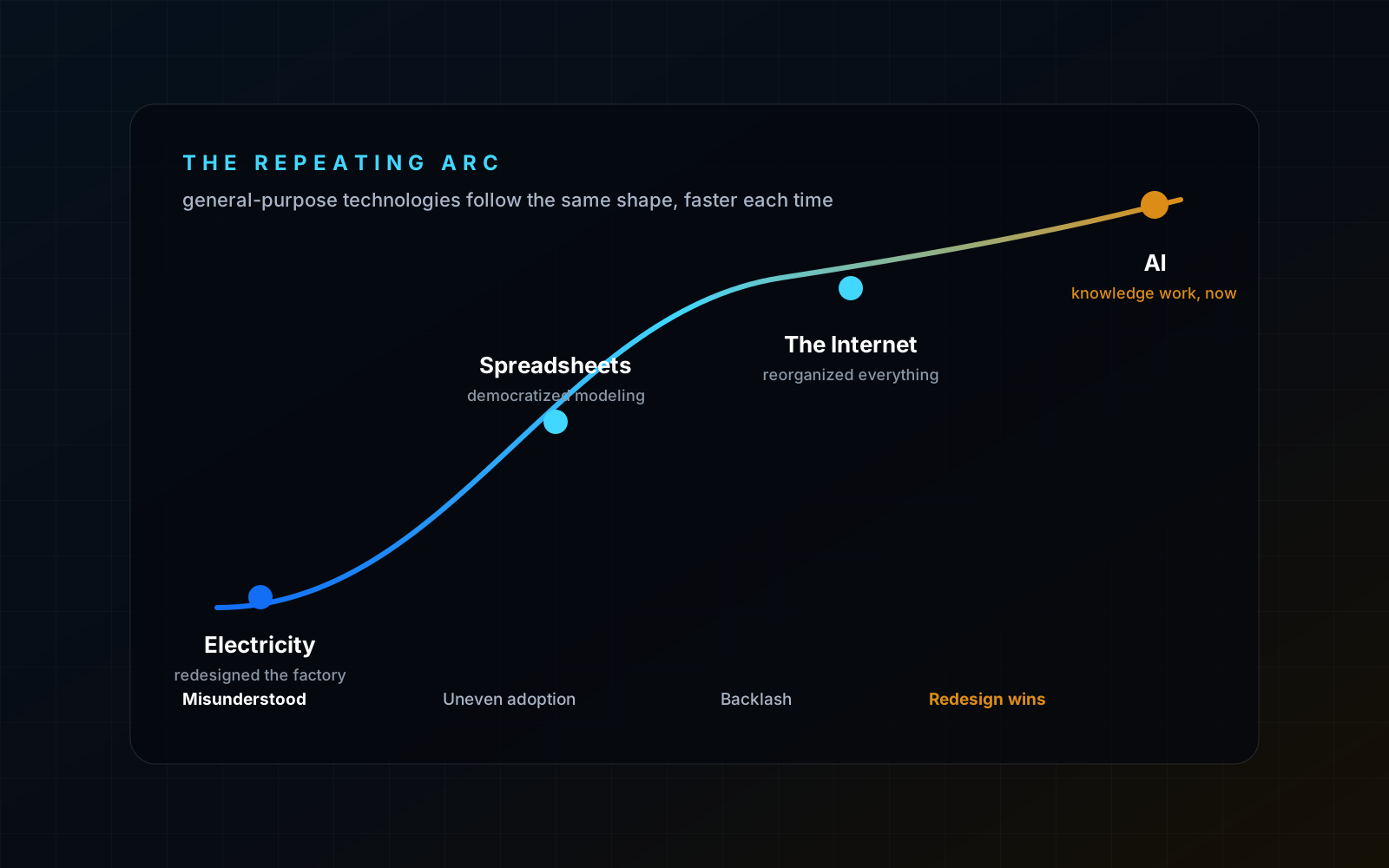
These shifts rarely show up as clean, orderly upgrades. They start out misunderstood, spread unevenly through people experimenting without much supervision, draw backlash from whoever stands to lose, and deliver their biggest measurable gains only after organizations rebuild work around them. Electricity, the computerized spreadsheet, the internet, and now AI all follow that shape.
If you are hoping for a quick win, the lesson is going to disappoint you. Buying the tool is the easy part; the advantage comes from everything you build around it. Redesigned workflows, new skills, governance, standards, measurement, a clear operating model: those are what turn a raw capability into something a competitor cannot copy overnight. This series traces that pattern across four technologies and turns it into a practical way to prepare for AI.
What a general-purpose technology actually is
Economists Timothy Bresnahan and Manuel Trajtenberg gave us a useful definition. A general-purpose technology is pervasive, it keeps improving, and it sets off what they called innovational complementarities: it spawns new inventions and methods across many sectors at once. Their stock examples were the steam engine, the electric motor, semiconductors, and the computer.
What sets a general-purpose technology apart from an ordinary tool is reach. An ordinary tool bolts one capability onto one process. A general-purpose technology spreads across industries, gets cheaper or better over time, and drags complementary change along with it in how organizations structure work, run processes, build infrastructure, and train people. The electric motor mattered because it eventually changed how factories were laid out, not because it spun a shaft. The spreadsheet mattered for a different reason entirely: it changed who got to build a financial model.
AI increasingly fits that definition. It shows up across industries and functions, it is improving fast, and its value leans heavily on complementary changes in process, data, governance, and people. That last point carries most of the weight. A general-purpose technology is only ever worth as much as the complements an organization builds around it.
The mistake is judging the new tool by the old workflow
The recurring error is to judge a technology while it is still crammed into the old institutional shape. The first electrified factories simply reproduced steam-era layouts. The first spreadsheet users treated the grid as a quicker calculator, and the first websites were brochures pasted online. The same thing is happening to AI right now, which most people still file under writing assistant, search tool, or novelty chatbot.
In each case that first use is real, just incomplete. The deeper change only comes when an organization stops asking how to slot the tool into the current process and starts asking how the process itself should change now that the capability exists. That second question is harder, and it is where convenience turns into something bigger.
The trap is easy to fall into, so it is worth saying plainly. A new capability appears, it clearly helps with some task people already do, and everyone declares victory right there. The bigger prize, rebuilding the work end to end, goes untouched, because nobody's job is to question the process the tool just got dropped into.
Productivity does not automatically follow adoption
Research on general-purpose technologies keeps landing on the same point: they pay off only alongside investment in new processes, products, business models, and people. Before those complements exist, the early productivity gains look small, sometimes small enough to be missed entirely. The technology has arrived; the payoff just has not caught up to it yet.
That gap explains why two companies can buy the same powerful tool and get opposite results, one seeing almost nothing while the other builds a lasting edge. Access is not what separates them, since access is cheap and nearly universal now. Integration is what separates them: whether they actually rebuilt the surrounding work, retrained people, changed their controls, and started measuring the things that matter.
So with AI, plan on a visible gap between access and advantage. Hand employees a chat tool and individual tasks get faster almost immediately. Enterprise-level value takes longer, because it rides on workflow redesign, new review steps, changed roles, updated controls, and clear accountability. The fast individual wins are real enough. They are just not the same thing as the larger change, and confusing the two is how programs lose patience right before they would have paid off.
AI is running the same arc, faster
The arc itself is old news. The speed is what is new. Stanford's 2026 AI Index reports that generative AI reached 53 percent population adoption within three years, faster than the personal computer or the internet, with organizational adoption hitting 88 percent. On raw diffusion, nothing in the record has moved this fast.
The same report carries a warning anyone who lived through the early internet will recognize: responsible-AI measurement and governance are falling behind capability, and AI incidents rose sharply in 2025. The capability shows up before organizations know how to govern it, measure it, or rebuild work around it. That distance between what a technology can do and what its institutions are ready for is the same one every earlier transition hit.
Speed raises the stakes. Back when diffusion took a decade, a company could muddle its way toward the complementary systems and still come out fine. Compress that to a few years and the gap between what the technology can do and what the organization is ready to do with it widens faster than improvised responses can close it. Preparation has to be deliberate now.
Language is the interface, so adoption is already happening
AI has an unusually low barrier to entry, because the interface is just language. The internet needed a connection, a browser, eventually broadband. Enterprise software needed procurement, configuration, training. AI needs a sentence typed in plain English. That makes adoption both fast and messy.
That low barrier produces shadow adoption. Employees who would never go install enterprise software on their own will happily paste confidential information into a public chatbot, drop AI-generated analysis into a client deliverable, lean on synthetic legal or financial language, or ship code they do not fully understand. Leadership can believe the company has not adopted AI because no big contract has been signed, while AI is already woven through drafting, research, coding, analytics, and customer messages.
Which is why pretending it is not happening solves nothing. AI is going to be used inside the company, and already is. The part still up for grabs is whether that use is intentional, governed, measurable, and tied to strategy, or accidental, invisible, and risky.
Treat AI as an operating-model transition
The argument of this series is simple. You do not solve AI adoption by getting access to models; you solve it by managing the transition with discipline. And the organizations that come out ahead will not be the earliest tinkerers or the loudest skeptics. They will be the ones that turn a raw technical capability into a governed, repeatable, measurable operating advantage.
That reframing matters because it changes who owns the problem. Treat AI as an IT procurement project and it lands on a single desk and stays there. Treat it as an operating-model transition and it becomes a question for the CEO, the board, operating leaders, risk, legal, HR, finance, and security, because it reaches into how work gets produced, supervised, measured, and improved across every function that touches information.
The rest of the series builds out both the case and the method. The next three parts look at electricity, spreadsheets, and the internet, because each one teaches a specific lesson, about lag, about democratized risk, about governance. From there I pull out the six patterns they share, work through why AI both fits the mold and breaks it, and lay out a ten-part preparation playbook and a three-horizon strategy. The aim never changes: to use AI on purpose instead of by accident.